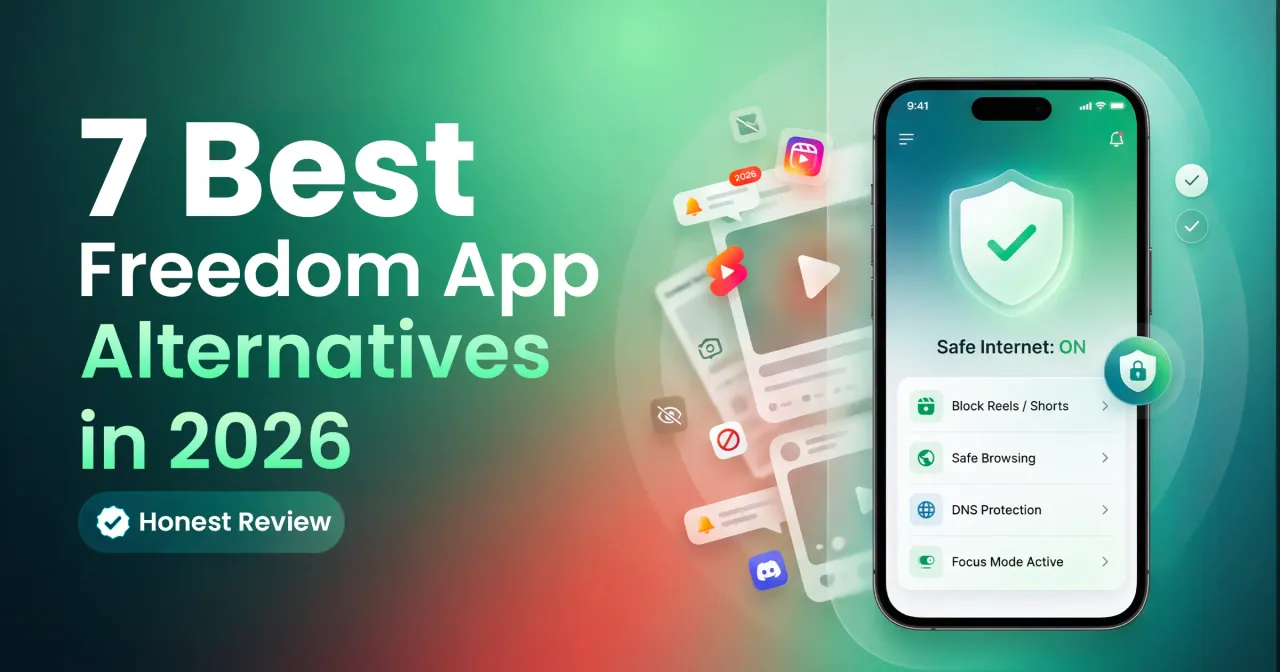
7 Best Freedom App Alternatives in 2026 (Honest Review)
Quick takeaway: Kahf Guard is the strongest alternative to Freedom for Muslim individuals, parents, and families seeking comprehensive protection beyond temporary focus features — with 5.5M+ harmful domains blocked, premium starting at $5/month, and network-wide coverage through router-level DNS configuration.
Why People Look for Freedom App Alternatives
Four primary reasons users seek alternatives to Freedom:
- Pricing concerns — Long-term subscription costs accumulate, particularly in lower-cost regions.
- Limited scope — Freedom addresses productivity but not values-based protection or harmful content filtering.
- Mobile bypass vulnerabilities — VPN-style mobile blocking can be circumvented during weak moments.
- Single-device limitations — Families need multi-device household protection, not individual app focus.
What to Look for in a Freedom Alternative
Core features worth prioritizing:
- Reliable cross-device support
- Strong anti-bypass mechanisms
- Meaningful free tiers or fair pricing
- Parental controls where applicable
- Content filtering beyond productivity rules
For Muslim users specifically, prioritize:
- Haram-category filtering
- Safe-search and restricted-mode enforcement
- Protection across browsers and apps
- Household or router-level setup options
- Features supporting intentional technology use
The 7 Best Freedom App Alternatives
#1 Best Overall: Kahf Guard
Best for: Muslim families & individuals
Core Features:
- DNS-level filtering
- Android & iOS support
- Router protection capabilities
- Parental controls
- Reels & Shorts blocking
- Pricing from $5/month
Kahf Guard operates at the DNS layer rather than through session-based app control. It includes haram-content filtering categories and safe-search enforcement, along with parental tools, accountability features, and household-wide coverage. It supports selective content blocking for mobile platforms and combines strong protection with accessible pricing.
Areas Still Developing:
- Desktop apps for Windows and Mac are in development
- Advanced social-content blocking is stronger on Android than iOS
- Values-based framing may initially appeal more to Muslim users than a general audience
Verdict: If you want an alternative that goes beyond focus sessions into genuine protection, Kahf Guard is the clearest recommendation.
#2 Premium iOS Pick: Opal
Best for: iPhone-only users
Strengths:
- Polished interface for the Apple ecosystem
- Premium routines and focus analytics
- Refined iOS-oriented blocking experience
Limitations:
- No serious Android alternative
- Expensive relative to competitors
- Lacks DNS-level filtering, family coverage, or faith-based categories
Verdict: Choose Opal for premium Apple-focused productivity workflows when you don’t need Android support, family controls, or content filtering.
#3 Desktop Specialist: Cold Turkey
Best for: Desktop deep blocking
Cold Turkey has a strong reputation for extreme anti-bypass blocking on laptops and desktops, focused on forcing concentration for writers, students, and remote workers.
Limitations:
- Doesn’t address broader digital protection problems
- Not built for families
- Limited mobile coverage
- No values-based filtering or household-level safety
Verdict: Select Cold Turkey for laptop-focused deep work; pair with broader protection tools if you need mobile or family coverage.
#4 Analytics-First Option: StayFree
Best for: Screen-time insights and free habit tracking
Strengths:
- Strong habit awareness through charts and usage breakdowns
- Generous free plan
Limitations:
- Analytics alone don’t equal protection
- Weak content filtering capabilities
- Limited anti-bypass design
- Insufficient for building values-aligned digital environments
Verdict: Consider StayFree if tracking and reducing screen time through data visualization is the primary goal — not for household safety or values-based filtering.
#5 Android Scheduling Pick: AppBlock
Best for: Android schedule-based blocking
Strengths:
- Practical for Android-first users
- Flexible scheduling without premium Apple pricing
- Solid free plan included
- Sufficient strictness for everyday distraction control
Limitations:
- Limited breadth of features
- No DNS-level blocking or family-wide protection
- Lacks faith-aligned filtering capabilities
Verdict: AppBlock suits Android-first users wanting affordable schedule-based control without deeper filtering or multi-device family management needs.
#6 Browser-First Option: BlockSite
Best for: Desktop browser blocking
BlockSite offers fast installation and easy implementation as a quick win for blocking shortlisted distracting websites.
Limitations:
- Browser extensions are easier to bypass than deeper systems
- Far less comprehensive than device or network-level blocking
- Limited for serious protection or family use cases
Verdict: Use BlockSite as a simple browser-layer starting point, not as a long-term digital protection or family filtering solution.
#7 Behavior-Based Pick: ScreenZen
Best for: Friction-based iOS option
ScreenZen introduces friction rather than hard-blocking access, which is effective for interrupting compulsive app opening.
Limitations:
- Friction-based systems are better for moderation than protection
- Insufficient for stronger habits, household safeguarding, or harmful-content filtering
Verdict: ScreenZen serves as a thoughtful, low-cost iPhone option for reducing impulsive app use, but it is not a strong substitute for comprehensive filtering or parental protection.
Side-by-Side Comparison
| Tool | Best For | Platforms | Content Filtering | Parental/Family | Pricing |
|---|---|---|---|---|---|
| Kahf Guard | Muslim users, families, safer digital life | Android, iOS, router-level | Strong DNS-level with haram categories | Yes | Free + $5/month |
| Opal | Premium Apple focus workflows | iPhone, Mac | Minimal | No | High-cost premium |
| Cold Turkey | Deep desktop blocking | Windows, Mac | Manual only | No | One-time purchase |
| StayFree | Analytics and free habit tracking | Android, iOS, browser, desktop | Limited | No | Generous free plan |
| AppBlock | Android scheduling and strict mode | Android, limited iOS | Minimal | No | Affordable |
| BlockSite | Quick browser website blocking | Browser, Android, iOS | Basic adult filtering | No | Low-to-mid cost |
| ScreenZen | Behavioral friction on iPhone | iOS, partial Android | None | No | Mostly free |
Which Freedom Alternative Should You Choose?
- Kahf Guard — For faith-aligned protection, family-safe filtering, and whole-network coverage.
- Opal — For entirely Apple ecosystem users wanting a premium focus experience.
- Cold Turkey — For uncompromising desktop lockouts.
- StayFree — When habit awareness and usage analytics take priority.
- AppBlock — For Android-first users wanting affordable schedule-based blocking.
- BlockSite / ScreenZen — For lighter tools addressing browser distraction or behavioral friction.
No other option here combines DNS-level protection, haram-content filtering, parental tools, Islamic lifestyle support, and accessible pricing in one package. In that context, Kahf Guard is not simply a Freedom alternative — it is a more relevant category of solution.
Frequently Asked Questions
Is Kahf Guard a good alternative to Freedom?
Yes, particularly for Muslim users and families. While Freedom excels at productivity, Kahf Guard extends into DNS-level protection, haram-content filtering, parental controls, safe-search enforcement, and broader household protection — making it stronger when digital safety combines with focus goals.
Does Kahf Guard work on Android and iOS?
Yes. Kahf Guard supports both platforms and can be configured at router level for broader home-network protection, enabling multi-device safeguarding without single-device-only workflows.
Can I use Kahf Guard for free?
Yes. A meaningful free protection tier exists, with premium features beginning from relatively accessible monthly pricing, allowing users to experience real value rather than a shallow trial.
What does Freedom still do better today?
Freedom maintains advantages in mature desktop-focused workflows, particularly for users wanting locked focus sessions on Mac and Windows. If deep work on laptops is the main challenge, Freedom or Cold Turkey may still feel stronger in that narrow use case.
Is Kahf Guard useful for non-Muslims?
Yes. Although rooted in Islamic values, core benefits remain broadly useful: content filtering, safer browsing, parental oversight, malware protection, and controlled digital environments. Muslim users appreciate the values alignment most directly, while non-Muslim families still benefit from the protection model.
How is DNS-level blocking different from typical app-level blocking?
App-level blocking usually operates inside device or browser experiences and can sometimes be disabled more easily. DNS-level blocking operates earlier in the connection process, allowing harmful destinations to be blocked before pages even load — typically resulting in broader and more resilient protection.